
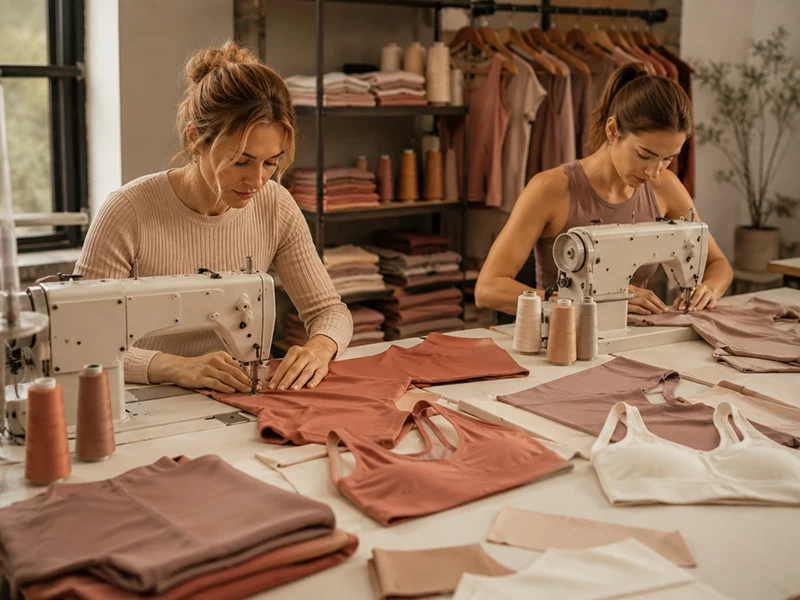
Same fabric, different product
Two leggings can be cut from the same roll of fabric, to the same measurements, and behave nothing alike. One stays up through a class and comes out of the wash unchanged; the other rolls at the waist, twists at the thigh and goes sheer at the knee. The variable is construction — specifically three details that are decided at sampling and then locked for the life of the style.
1. The waistband: where most fit complaints originate
The waistband has to do two contradictory things: grip the body firmly enough not to slide, and not dig in when the wearer sits down. There is no single answer, which is why the choice should follow the product brief.
| Waistband type | How it is built | Behaviour | Suits |
|---|---|---|---|
| Single-layer self-fabric | One layer of the main fabric, folded and stitched | Lightest, least grip, can roll on soft fabrics | Low-impact and everyday styles |
| Double-layer self-fabric | Two layers of main fabric, no elastic | Stays flat, good grip without a hard edge | Most sculpting leggings |
| Elastic-inserted | Elastic encased inside a fabric channel | Strongest grip, tightest fit | Training and high-compression styles |
| Contoured / V-front | Shaped panel that dips at the centre front | Reduces pressure on the stomach, flattering line | High-waist fashion-led styles |
Two construction details matter as much as the type. First, how the elastic or band is anchored: a waistband stitched only at the top edge will roll; one anchored at both top and bottom, or bonded, will not. Second, the rise — a high-waist legging that is too short in the rise will slide down no matter how strong the elastic is.
2. The gusset: a small panel that prevents a large problem
The gusset is the diamond- or triangle-shaped panel at the crotch, usually two or three pieces. It exists for two reasons: it removes the single seam that would otherwise run through the crotch and cause discomfort and chafing, and it allows the garment to accommodate movement without the fabric pulling tight enough to go sheer.
Skipping or undersizing the gusset is one of the most common cost-driven compromises in low-cost leggings, and it is visible to the customer immediately. A properly proportioned gusset is cut from the same fabric as the body — or from a lining fabric where extra breathability is wanted — and it is sewn with flat seams so nothing sits proud against the skin.
3. Seams: flatlock, overlock and coverstitch
Activewear lives or dies on seam comfort. Every seam that sits against the skin is a potential source of chafe, and every seam is a potential point of failure under stretch.
- Flatlock (flat seam) — the standard for activewear. The seam is sewn and then flattened so it lies flush, distributing stretch across the stitch and giving a smooth inner face.
- Overlock (serging) — faster and used on edges and non-contact seams. It leaves a raised seam, so it should not be placed where it will rub.
- Coverstitch — used at hems and on folded edges, giving a clean finish with stretch. Standard at leg openings and on waistbands.
Alongside the seam type, stitch density and thread decide whether the seam survives washing. Too few stitches per inch and the seam gaps when stretched; the wrong thread and the seam fails before the fabric does.
Four checks before approving a leggings sample
- Squat test. The wearer performs a full squat; check the knee, seat and inner thigh for sheerness in the lightest colourway.
- Waistband roll test. Sit, stand, bend forward and back. A waistband that rolls at any point will roll for the customer.
- Seam flatness. Run a hand inside the garment along every seam. Anything you can feel will chafe.
- Wash and recovery. Wash at the temperature the care label will state, dry as stated, and re-measure against the approved spec.
These take an hour at sampling and prevent the two problems that generate most activewear returns: sheerness under stretch and a waistband that will not stay up. We build leggings, jumpsuits and shorts on this basis at our Guangzhou factory, with pattern development, flatlock sewing and pressing all carried out in-house.