
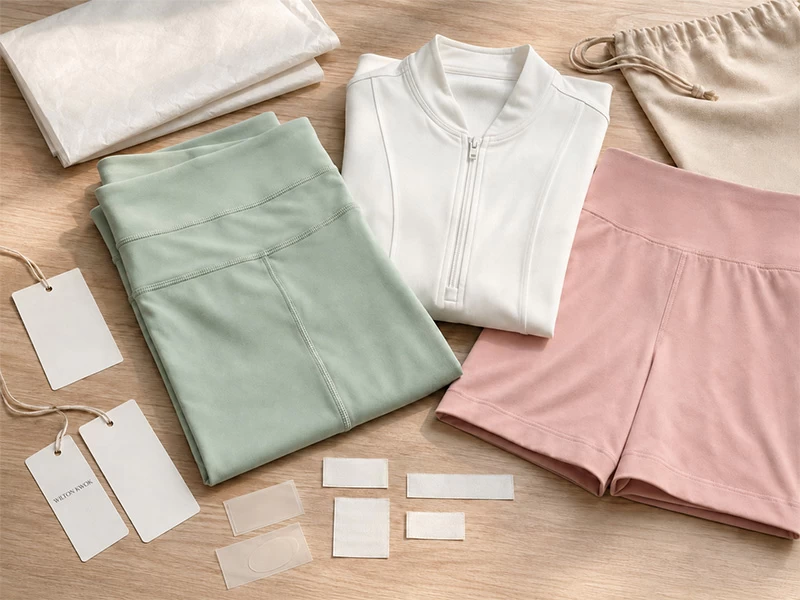
Fabric is a product decision, not a sourcing detail
When a brand briefs a new leggings range, the conversation usually starts with colour and silhouette. The decision that actually determines whether the product sells is the fabric — because compression, opacity, recovery and hand feel are all set by it, and none of them can be fixed later by cutting or stitching.
We run four fabric families across our yoga activewear ranges. They are not good-better-best tiers; they are different answers to different product briefs, and the common mistake is treating the highest-compression option as automatically the best one.
The four families compared
| Fabric | Feel | Compression | Surface | Best suited to |
|---|---|---|---|---|
| Softsculpt | Ultra-soft with a subtle sheen | Medium | Naturally breathable, light sheen | Leggings and sets for all-day wear, high-intensity and lounging alike |
| Airlift | Sleek and sculpting | High | Subtle sheen, snug fit | Training leggings and shorts where hold matters most |
| Airbrush | Soft, cottony | Medium | Matte, 4-way stretch | Everyday leggings, travel and casual activewear |
| Soft | Buttery-soft, brushed | Minimal | Lightweight brushed finish | Low-impact and recovery wear, layering pieces |
Compression: what it changes on the body
Compression is the single most consequential variable. Higher compression holds the muscle and smooths the silhouette, which is what most customers associate with a "sculpting" legging. It also means the garment resists being put on, and it demands a more precise fit — a high-compression legging that is 2 cm too long will pool at the ankle rather than drape.
Airlift suits a training brief. It is the fabric for a product where the customer expects hold and support, and where the design has enough coverage that the snugness reads as intentional.
Hand feel and the "quiet luxury" brief
Softsculpt was developed for the brief that has dominated premium activewear for the last few years: a garment that looks refined enough to wear outside the studio. It has medium compression, so it is comfortable for hours, but a subtle sheen that reads as more considered than a matte sports fabric. It is the fabric we use most for coordinated yoga look sets, because the sheen and hand feel carry across a top and a legging without looking like gym kit.
Airbrush, Soft and the everyday segment
Airbrush is the workhorse. A matte, cottony hand feel and medium compression make it forgiving across body types, and the 4-way stretch handles movement without reading as performance wear. It is the fabric for a brand whose customer is buying leggings for daily life rather than for a training block.
Soft is deliberately the lightest option. Minimal compression, brushed finish, low weight — it belongs in recovery wear, layering and the sort of piece a customer wears for a morning errand. Placing Soft in a high-impact product is a common error: the fabric is not built to hold under load.
Opacity, recovery and the tests that matter
Two fabric properties cause more returns than any other in activewear, and both should be tested at sampling rather than discovered by customers.
- Opacity under stretch. A legging that is opaque when standing can go sheer at the knee in a deep squat. Test the fabric at the stretch level the garment will actually see, in the lightest colourway in the range — not in black.
- Recovery after wear. Measure the fabric, wear or stretch it to the garment's limit, release, and measure again. A fabric with good compression but poor recovery will bag at the knee and seat within a few hours of wear.
Both tests are cheap and both are best run on the actual production fabric lot, not on a lab sample supplied at the enquiry stage.
Matching fabric to product: a short framework
- Decide the primary use case first — training, studio, or everyday — and let compression follow from it.
- Choose the surface finish against the brand's visual language: sheen for a refined look, matte for a technical one.
- Confirm opacity at the maximum stretch of the designated garment, in the lightest colour.
- Confirm recovery on the production fabric lot before bulk cutting.
- Check that the same family carries into the top or short in the set, so the range reads as a collection.
We develop and cut all four families in-house at our Guangzhou facility, which means a brand can test the same style across two or three fabrics and decide from samples rather than from a swatch book.