
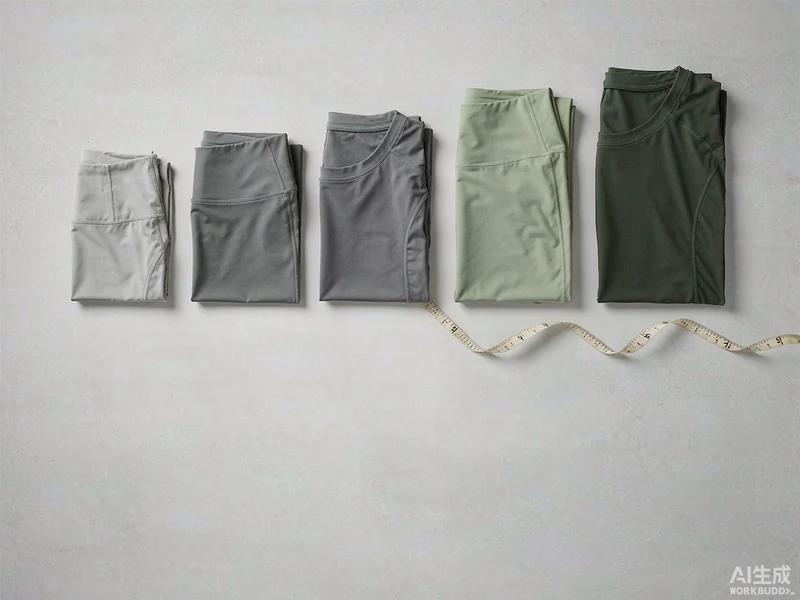
Quick answer: Grading is the step where one approved sample becomes a size run. It is also where most returns originate, because a grade rule that works on the middle size often fails at both ends. Approve a fit set by measuring every size against the rule — not by fitting the mid size — and specify the grade rule per dimension rather than as a single scale factor.
Returns attributed to sizing are usually treated as a marketing problem: better size guides, more model measurements, a fit finder widget. They are more often a grading problem, and a grading problem is cheaper to fix at the sampling stage than at any point afterwards.
What grading actually does
Grading takes an approved base size and derives every other size by applying increments to each measurement. The increments are the grade rule. The rule is not a single scaling factor — it is a set of increments, one per measurement point, chosen so that the garment continues to fit a real body as it gets larger or smaller.
Bodies do not scale uniformly. Between a size S and a size L, the bust and hip increase more than the shoulder width, and the waist increases more than the rise in some categories and less in others. A grade rule that applies a uniform percentage to every dimension will produce garments that fit at one end of the range and not at the other.
The increments that matter, by category
| Measurement | Typical increment per size | Note |
|---|---|---|
| Waist (relaxed) | 4-5 cm | Should track the target body, not the fabric recovery |
| Hip | 4-6 cm | Usually the largest increment in activewear |
| Thigh circumference | 2-3 cm | Critical on leggings and shorts; often under-graded |
| Inseam | 0-1 cm | Nearly constant across sizes for a fixed style |
| Front rise | 0.5-0.8 cm | Much smaller than most people assume |
| Back rise | 0.8-1.2 cm | Larger than front rise; the difference grows across sizes |
| Torso length (one-piece) | 1-1.5 cm | The dimension that most often breaks jumpsuit grading |
| Shoulder width | 0.8-1.2 cm | Smaller than bust increment; commonly over-graded |
| Sleeve length | 0.5-1 cm | Often held nearly constant |
These are working ranges, not universal values — the correct increment depends on the target body and the fabric. What matters is that each dimension has its own increment and that the increments are documented, rather than a single scale factor applied across the pattern.
Why activewear grading is harder
Three properties of activewear make grading less forgiving than in other categories:
- Negative ease. Activewear is designed to be worn stretched. The garment measures smaller than the body, and the fit depends on the fabric recovering predictably. As sizes increase, the required stretch percentage changes — which means grade increments interact with fabric properties, not just body dimensions.
- High stretch masks errors at the mid size. A sample in size M will look acceptable on a range of wearers because the fabric absorbs the error. That tolerance disappears at size XL, where the garment cannot stretch further.
- Construction limits. A waistband elastic has a maximum elongation. Beyond a certain body circumference, the same elastic specification stops holding. Grading past that point requires a construction change, not just a measurement change.
The fit-set approval process
A fit set is one sample per size, graded from the approved fit. Approve it in five steps:
| Step | What to do | What it catches |
|---|---|---|
| 1 | Lay the set out in size order and check the visual progression | Obvious grading errors — a size that does not step proportionally |
| 2 | Measure every size at every point, against the rule | Increment errors, tolerance drift |
| 3 | Compare measured increments to the specified rule | Whether the factory graded to your rule or to their standard |
| 4 | Fit the smallest and largest sizes on real wearers | Whether the rule works at the ends, not just the middle |
| 5 | Review the two ends in motion — hinge, squat, reach | Fit failures that only appear in larger or smaller sizes |
Step 4 is the one most often skipped, and it is the one that matters. A fit set approved on the mid size is a fit set that has not been tested.
The measurement record you should require
Ask for a measurement sheet with every size measured, not just the base size. It should show:
- Every measurement point in the tech pack, for every size.
- The specified value and the tolerance for each point.
- The measured value, and the deviation.
- The name of the person who measured, and the date.
Insist on measurement in a conditioned state where the fabric specification calls for it — relaxed measurement after a stated resting period, not immediately after pressing. Fabric that has just been steamed will measure longer than the same fabric after twelve hours, and the discrepancy is enough to fail an otherwise correct size set.
What grading failure costs
A grading error that reaches bulk affects one or more entire sizes. The commercial consequences stack: the affected sizes do not sell, they come back as returns, the returns cannot be resold at full price, and the reorder that would have followed does not happen. On a 3,000 piece order, a single badly graded size is often 15-20% of the order and the majority of the season's return volume.
The cost of preventing it is one fit set — a few hundred dollars of samples and a few days of measurement. This is the highest-return quality control in the production process, and it is routinely compressed to save a week.
Frequently asked questions
What is a fit set and why is it needed?
A fit set is one sample per size, graded from the approved fit sample. It proves that the grade rule produces a wearable garment at every size, not just the base size. It is the only stage where grading errors can be caught before bulk production.
Can I grade activewear the same way as woven apparel?
No. Activewear is designed with negative ease, so fit depends on fabric stretch and recovery interacting with the grade increments. Woven apparel grading assumes the garment measures to the body; activewear grading has to account for how much the fabric will stretch at each size.
How much does grading differ between sizes?
It differs per dimension, not per size uniformly. Hip and thigh typically change most, inseam and sleeve length change least, and rise changes by less than most people expect. A single scale factor applied across all dimensions will fit the middle size and fail at the ends.
Should measurements be taken on the sample straight after pressing?
No. Measure after the fabric has rested for the period specified in the tech pack, typically twelve hours. Freshly pressed or steamed fabric measures longer, and the difference is often enough to fail a correct size set or, worse, to approve an incorrect one.
How many sizes should a fit set cover?
Every size in the range. Grading errors appear at the ends of the range, so a fit set covering only the middle sizes defeats the purpose. If cost is a constraint, cover the smallest, the base and the largest, and measure the intermediate sizes from the pattern.
Want a grading review on an existing size run before your next bulk order? Send us your brief and we will come back with a feasibility opinion within two working days.