
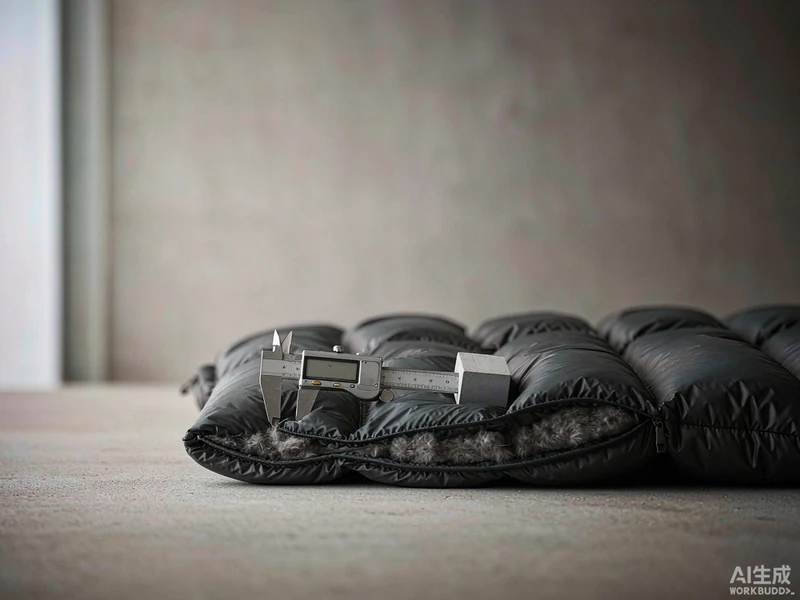
Quick answer: A down jacket loses warmth for two reasons that never appear on a spec sheet — uneven fill distribution between chambers, and poor loft recovery after compression. Both are factory-floor decisions, and both can be verified with simple, cheap tests before bulk is released. A 700 fill power down that recovers 95% of its loft outperforms an 800 fill power down that recovers 80%.
The gap between a fill power certificate and a warm jacket
A fill power number describes one ounce of down under laboratory conditions. It is measured in a conditioned room, on a sample that has been through a mechanical conditioning cycle, with a weighted piston applying a known pressure. It tells you about the fill, not about the garment.
Once that down is inside a sewn jacket, four new variables decide whether the customer is warm: how evenly it is split between chambers, how much of it is in each chamber, how the shell and baffles let it recover, and how the finished garment survives the compression of shipping. A buyer can approve a fill power certificate, pass the lab test, and still receive a jacket that feels cold across the shoulder blades and flat at the hem — because a chamber that received 18% less down than its neighbours is invisible on any document.
This is the most common quality complaint we see on down programs, and it is almost never a down problem. It is a distribution and recovery problem.
Why chambers go out of balance
Down is not a fluid. It does not self-level inside a garment the way liquid would, and the reason is mechanical: clusters are held in place by the baffle geometry and by inter-cluster friction. Once a chamber is closed, the fill inside it mostly stays where it was placed. Whatever imbalance is created at the filling station persists for the life of the garment.
Four conditions create imbalance, and all four are controllable:
- Volumetric filling instead of weighed filling. Filling by volume or by time assumes down density is constant. Between lots — and even within a lot — it is not. Humidity, cluster integrity and static all change how much down passes through the nozzle per second. A weighed dose is the only reliable measure.
- Static and moisture contamination. Dry, cold air and synthetic shell fabric generate static, which makes clusters cling to the filling tube and to chamber walls. Oily or damp compressed air creates clumps that will not separate. Both produce chambers that are visibly under-filled after tumbling.
- Chamber geometry without a fill map. A jacket with different chamber volumes — a large body chamber versus a narrow sleeve channel — demands a different gram dose per chamber. Factories that apply one gram target across all chambers will systematically overfill small chambers and underfill large ones.
- Late-stage handling. Chambers that are filled correctly can still be flattened by pressing, folding or vacuum packing before the down has had time to expand. Compression that exceeds what the baffle can recover from sets a crease that never fully opens.
What "distribution" actually means in a specification
Distribution is not a vague quality goal. It can be written as three clauses a factory can be held to:
- A chamber map with a gram dose per chamber. Each chamber or group of chambers in the tech pack gets its own target fill weight, referenced to the size being produced. The sum across all chambers should reconcile to the total fill weight for that size, and that reconciliation is the first check.
- A dosing tolerance. State the acceptable deviation per chamber — typically a percentage of target, not an absolute gram figure, so the tolerance scales with chamber size. The tolerance should be tight enough to be measurable on a production floor scale and wide enough that it does not generate false rejections.
- A verification method. Distribution cannot be verified by looking at a hanging garment. It is verified either by weighing the finished shell before and after filling, or by inspecting chambers under transmitted light on a light table, which makes thin and empty chambers visible as bright patches.
The practical version of this, at the filling station, is a scale and a checklist per chamber. It sounds unglamorous. It is the single highest-return change on a down program.
Loft recovery: the test that predicts customer complaints
Loft recovery asks a simple question: after the garment is compressed — in a carton, in a warehouse, in a suitcase — does the down come back?
The fill power test itself includes a conditioning step precisely because down is hygroscopic and a compressed sample will not loft fully. The same principle applies to finished garments, and the industry-standard way to check it is a tumbling test on the finished piece:
- Measure the garment's loft at defined points — typically shoulder, chest, hem and one sleeve — using a consistent method. A simple thickness gauge on a flat surface is adequate; the value of the test comes from the comparison, not from absolute precision.
- Compress the garment to the level it will see in shipping, hold it for a defined period, and release.
- Tumble or shake under controlled conditions for a set time.
- Re-measure at the same points and express recovery as a percentage of the original loft.
The absolute numbers matter less than two things: the spread between measurement points, which reveals distribution problems, and the ratio between first and second measurement, which reveals recovery problems. A garment that measures uniformly but recovers poorly will feel thin after a week of wear. A garment that recovers well but measures unevenly will feel cold in specific places from day one.
Down leakage and why it looks like a distribution problem
Chambers that appear to empty over time are usually not losing their fill evenly — they are leaking at the weakest point. Migration happens through needle holes, baffle end closures and the small gaps at pocket and zipper compartments, and it is governed by two things: the down-proofing of the shell fabric, and the stitch density on the seams.
Air permeability is the measurable proxy for down-proofing. A shell that lets air through freely will let clusters through eventually. On the stitching side, stitches per inch is the controlling variable — too few and the needle holes are large enough for a cluster to work through, too many and the fabric is weakened along the seam line and the holes enlarge under load. Both variables belong in the tech pack as numbers, not adjectives, and both are covered in our guide to down proofing and fabric selection.
The two tests that catch this before the customer does are a fabric air permeability report per fabric lot and a tumbling leakage test on a pre-production sample built with bulk materials. A dark lint-free cloth rubbed over the finished garment gives a fast visual check of surface transfer — cheap, repeatable, and easy to add to an inspection routine.
Where this fits in the order timeline
None of these checks add meaningful time if they are placed correctly:
| Stage | Check | What it catches |
|---|---|---|
| Fabric approval | Air permeability report per fabric lot | Shells that will leak over time |
| Down lot approval | Composition and fill power certificate per lot | Fill that does not match the spec |
| Pre-production sample | Tumbling leakage test, loft measurement at four points | Distribution errors, seam weaknesses, poor recovery |
| In-line | Chamber fill weight check at defined intervals | Drift in dosing at the filling station |
| Final inspection | Light table inspection, surface rub test, loft spot check | Visible thin chambers, fluff transfer |
The sequencing matters because the cheapest place to fix a distribution problem is at the pre-production sample, and the most expensive place is at final inspection. Our sample to bulk production timeline sets out where each of these gates sits, and the factory audit and inspection checklist covers how to verify that the gates are actually being run rather than just documented.
What to put in the tech pack
If you specify only two things from this article, specify these: a chamber map with a gram dose per chamber and a stated tolerance, and a loft recovery requirement measured on a compressed and re-tumbled pre-production sample. Both are cheap to write, both are measurable, and both close the gap between a fill power certificate and a jacket that stays warm.
The fill power, fill weight and baffle specification is the starting point — our guide to specifying a down jacket covers how those three numbers interlock. Distribution and recovery are what determine whether the specification survives contact with a sewing line.
Specifying a down program and want the fill checked properly?
We develop and produce down outerwear at our Guangzhou facility, and we will run a loft recovery and chamber distribution check on your pre-production sample before bulk is released. Send us your tech pack and target fill specification for a production assessment.
Frequently asked questions
Does a higher fill power guarantee a warmer jacket?
No. Fill power describes the loft of a conditioned sample of down. Warmth in a finished garment depends on fill power, fill weight, distribution, baffle construction and loft recovery together. A lower fill power down that is distributed evenly and recovers well can outperform a higher fill power down that is unevenly filled or has poor recovery.
How much fill weight variation between chambers is acceptable?
The tolerance should be written into the tech pack as a percentage of the chamber target rather than a fixed gram figure, so that it scales correctly between a large body chamber and a narrow sleeve channel. Setting a percentage tolerance that is measurable on a production floor scale is more useful than a very tight tolerance that cannot be checked reliably.
Why does a jacket look full on arrival but feel thin after a week?
That pattern points to loft recovery rather than fill quantity. If the fill weight is correct and the chamber distribution is even, poor recovery after compression is the usual cause. A tumbling test that compresses and releases the garment, then re-measures loft, will confirm it before bulk production.
Can down distribution be corrected after the jacket is sewn?
Only with difficulty. Down does not self-level inside a closed chamber, so redistribution requires opening a seam, which is rarely economic on a finished garment. This is why chamber-level weighed dosing and a pre-production distribution check are worth setting up before the first bulk order.