
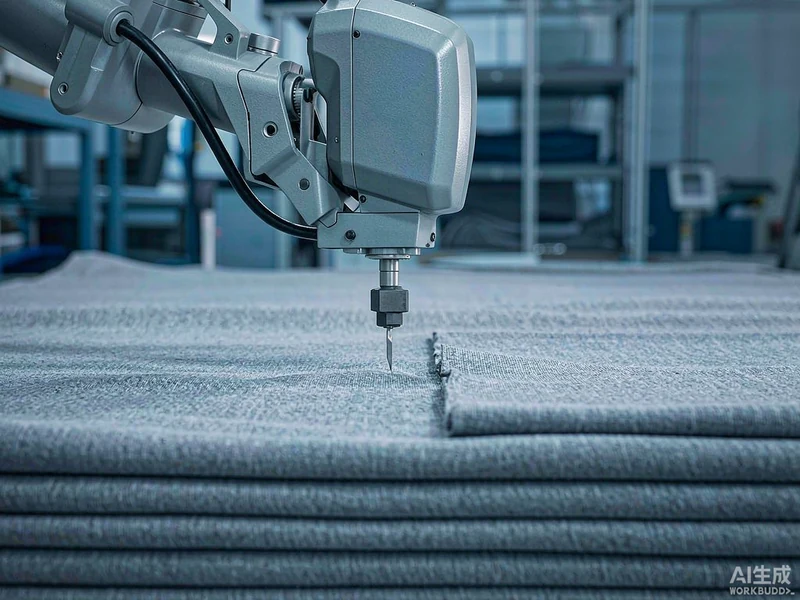
Quick answer: Automated cutting changes three things that matter to a buyer: ply-to-ply accuracy within a lay, tolerance at the cut edge, and fabric utilisation through tighter markers. It does not remove the operator — spreading tension, ply alignment and lay height still decide whether the cut is good, and those are manual decisions made before the blade moves.
The cutting room is the first place where a design becomes a physical object, and it is where tolerance is set for everything that follows. A 3 mm error at the cut edge becomes a 3 mm error at the seam, and by the time the garment is finished it has become a measurement that fails inspection. This is why cutting room capability matters more than its output per hour.
The four stages of a cutting room
| Stage | What happens | What automation changes |
|---|---|---|
| Marker making | Pattern pieces are nested on the fabric width to minimise waste | Nesting software explores combinations no manual marker would find |
| Spreading | Fabric is laid in plies to the required lay height | Automatic spreaders control tension and ply alignment |
| Cutting | Pieces are cut from the lay | CNC knives cut to the digital marker with consistent force and offset |
| Ticketing and bundling | Pieces are numbered and bundled for sewing | Digital ticketing links each bundle back to the cut record |
Where the accuracy gain actually comes from
A manual straight knife is operated by hand against a pattern line, and the operator's accuracy varies with lay height, fabric weight and how long they have been cutting. On a 40-ply lay of a light knit, the bottom plies frequently deviate from the top, because the blade deflects and the fabric shifts.
A CNC cutter eliminates blade deflection as a variable: it applies controlled force, compensates for the blade offset in software, and cuts the same path on every ply. The measurable result is a reduction in ply-to-ply variance — typically from a spread of 2-4 mm on a manual lay to under 1 mm on an automated one, on similar fabric.
For activewear with negative ease this matters more than it sounds. A garment designed to be worn stretched has very little tolerance margin: a 3 mm deviation in the waistband circumference of a legging translates into a fit difference the wearer can feel. Cutting accuracy is therefore a fit variable, not only a cost variable.
Fabric utilisation: the largest financial effect
Fabric is typically the largest single cost line in an apparel quotation. Small improvements in utilisation therefore move the price more than almost any other operational change.
| Marker approach | Typical utilisation | Constraint |
|---|---|---|
| Manual marker, single size | 78-84% | Limited by human patience and nesting skill |
| Manual marker, mixed sizes | 82-87% | Better, but depends on operator experience |
| Software nesting, mixed sizes | 86-91% | Limited by the number of size combinations trialled |
| Software nesting with leftover management | 88-93% | Requires accurate fabric width and flaw mapping |
A move from 84% to 90% utilisation is a 7% reduction in fabric consumption per garment, which on a fabric-heavy product is close to a 4-5% reduction in FOB cost. That is usually larger than the margin a buyer negotiates for over several rounds.
The limiting factor is rarely the software and usually the data: an inaccurate fabric width, an unrecorded flaw in the roll, or a size ratio that does not match demand all reduce achievable utilisation regardless of the nesting engine.
What still depends on the operator
Automation changes the nature of cutting skill rather than removing it. The decisions that still determine quality:
- Spreading tension. A spreader set too tight stretches the fabric; too loose and the plies shift during cutting. Tension has to be set per fabric, and the correct setting is a judgement based on how the material behaves.
- Ply alignment. Even plies, aligned selvedges and correct ply count are prerequisites — a CNC cutter cutting a badly spread lay produces a precise reproduction of a bad lay.
- Lay height. Taller lays are more efficient but increase ply-to-ply deviation and fabric distortion at the bottom. The optimum height is fabric-specific.
- Fabric flaw handling. Where a flaw is found in a roll, the decision to cut around it, splice, or reject the section is a judgement call with cost consequences.
- Shade and direction. One-way fabric, nap and shade variation require directional laying, which reduces utilisation. Recognising when this is required is an operator decision.
What this means for a buyer
Three practical implications when you evaluate a factory's cutting capability:
- Ask for the ply-to-ply tolerance they work to, and ask how it is verified. A factory that measures its own lay accuracy can tell you; one that cannot has not measured it.
- Ask what utilisation they achieve on your fabric and marker, and whether that number is quoted or measured. Utilisation claims that are not measured are usually optimistic.
- For stretch or lightweight fabrics, ask specifically about the spreading equipment, because that is where the quality of the cut is actually decided.
The limit of automation
Cutting automation improves consistency and utilisation, and it does both reliably. It does not compensate for a bad pattern, an unclear tech pack, or fabric that varies across the roll. Those remain the dominant causes of cutting-related failure, and no amount of machine accuracy fixes a pattern that was wrong before the fabric was spread.
Frequently asked questions
Does automated cutting improve garment quality?
It improves consistency of the cut, particularly ply-to-ply accuracy within a lay, which in turn reduces measurement variation in the finished garment. It does not improve a pattern that is incorrect, and it does not compensate for badly spread fabric.
How much fabric can automated nesting save?
Moving from manual marking to software nesting with mixed sizes typically improves utilisation by 4-8 percentage points on comparable fabric. On a fabric-heavy product that can translate to a 3-5% reduction in FOB cost.
Is automated cutting suitable for small orders?
The cutting itself is, but the setup — digitising the marker, programming the machine, running a test cut — is a fixed cost. Below a few hundred pieces per style the fixed cost can outweigh the utilisation gain, which is why small runs are often still cut manually.
What is ply-to-ply tolerance and why does it matter?
It is the maximum deviation between the top and bottom ply of a cut lay at the same point. On a manual lay with a long knife it can reach 2-4 mm because the blade deflects. On a CNC cutter it is typically under 1 mm. In close-fitting stretch garments, that difference is felt by the wearer.
What should I ask a factory about its cutting room?
Ask three things: the ply-to-ply tolerance they work to and how it is measured, the fabric utilisation they achieve on your specific fabric and marker, and what spreading equipment they use for stretch fabrics. The third question usually distinguishes a factory that understands cutting from one that has bought a machine.
Want to see our cutting room specification and utilisation data for your fabric? Send us your brief and we will come back with a feasibility opinion within two working days.