
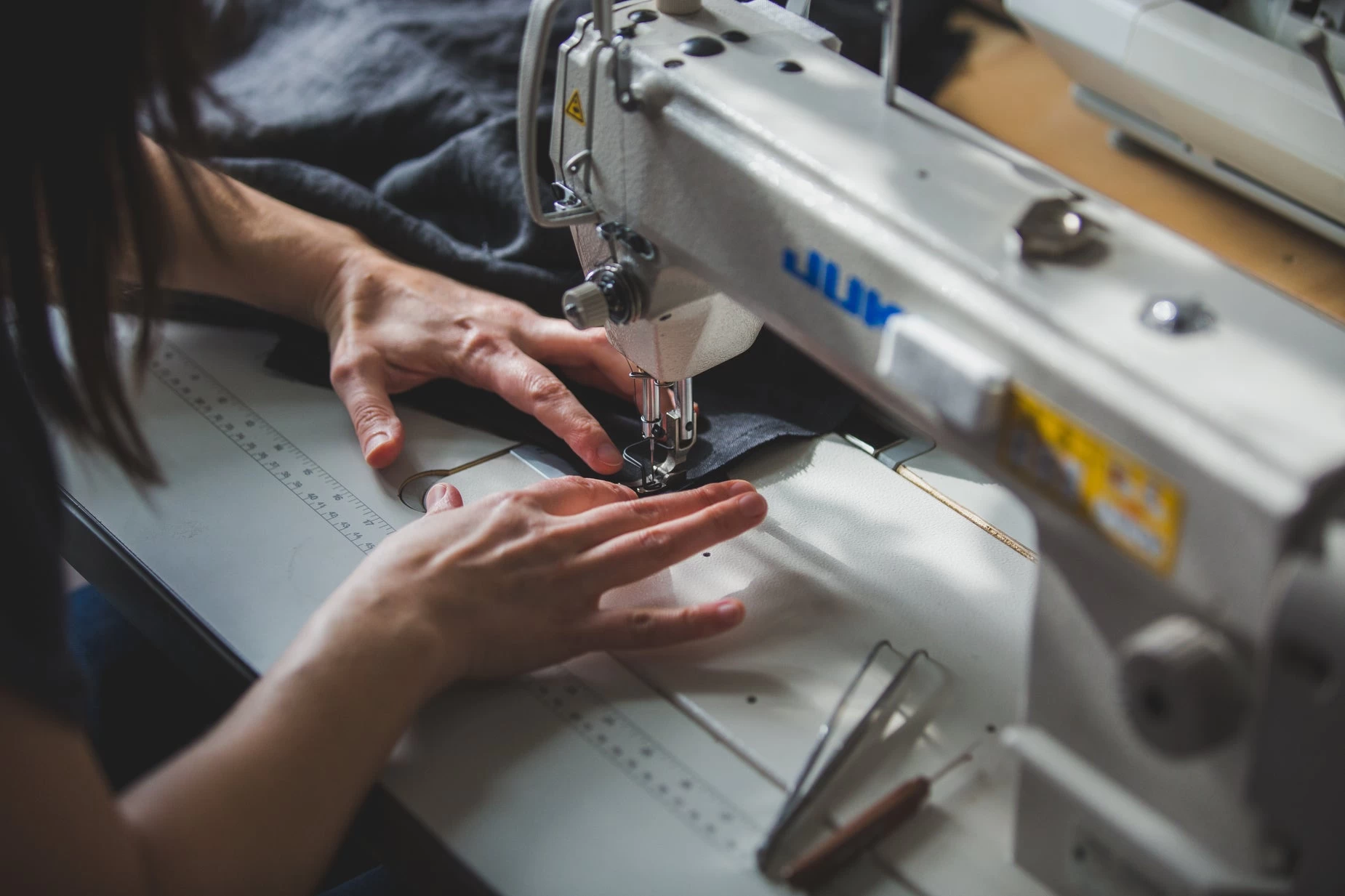
Quick answer: Quality is controlled at three separate points, not one. Before the order: a factory audit covering capability, equipment, labour practice and traceability. During production: in-line inspection after a defined share of the order is complete. Before shipment: a final random inspection against an AQL level — commonly AQL 2.5 for major defects and AQL 4.0 for minor. Buyers who inspect only at the end are inspecting consequences, not causes.
Most quality problems in apparel are not mysteries. They are foreseeable, and they are avoidable if you check the right things at the right time. A final inspection that finds a systematic issue has arrived about six weeks too late — the goods are made, the fabric is consumed, and the only remaining options are rework or rejection.
This guide sets out a three-stage approach: what to verify before you commit, what to check while the order is running, and how to structure the final inspection. It is written for buyers of activewear and down outerwear specifically, because both categories carry failure modes that generic checklists miss.
In this article
- Why three inspection stages, not one
- Stage 1: the factory audit
- Capability and equipment verification
- Material traceability and certification
- Labour practice and social compliance
- Stage 2: in-line inspection
- Defects specific to activewear
- Defects specific to down outerwear
- Stage 3: final inspection and AQL
- The master checklist
- Frequently asked questions
Why three inspection stages, not one
A single final inspection answers one question: are these goods acceptable? It cannot answer why they are not, and it cannot prevent the cost of remaking them. Splitting quality control across three stages answers the more useful questions.
| Stage | When | Question it answers | Cost if skipped |
|---|---|---|---|
| Factory audit | Before placing the order | Can this factory make my product consistently? | Discovering a capability gap after the fabric is cut. |
| In-line inspection | At 20–40% of production complete | Is the process producing conforming goods right now? | A systematic defect multiplied across the whole order. |
| Final inspection | After 100% packed, before shipment | Does this shipment meet the agreed specification? | Shipping non-conforming goods and managing returns. |
| Mid-documentation review | At PP approval | Is the agreed standard written down and traceable? | Disputes with no reference point for "agreed". |
The economics are straightforward. A defect caught in-line costs one garment to fix. The same defect caught at final inspection costs the garment plus the unpacking and repacking. Caught by the end customer, it costs the garment, the freight both ways, the refund and a share of your brand equity.
Stage 1: the factory audit
A factory audit is not a tour. A tour shows you the best-lit room and the newest machine. An audit verifies claims against evidence — and the specific claims that matter are capability, capacity, traceability and labour practice.
Ask for the audit to be conducted on a normal production day, without advance notice of which lines will be visited, and ask to see the whole production floor rather than a prepared section.
Red flag: if a factory resists an unannounced audit, or steers the visit to a fixed route, treat that as evidence in itself. Factories with nothing to hide generally welcome scrutiny — it is a competitive advantage for them.
Capability and equipment verification
Capability questions are about whether the factory can physically produce your product, not apparel in general. Activewear and down outerwear each require equipment that a general cut-and-sew operation may not have.
| Capability | What to verify | Why it matters for your product |
|---|---|---|
| Flatlock / coverstitch machines | Number of units, in working order, not idle | Activewear seams are predominantly flatlock; without dedicated machines, seam quality suffers. |
| Bartack and lockstitch stations | Count relative to sewing lines | Stress points on leggings and shorts rely on bartacks. |
| Down filling equipment | Filling machine, weighing scale accuracy, fill containment | Hand-filled down is inconsistent; weighed filling is repeatable. |
| Baffle / quilting capability | Quilting machine width, templates per baffle dimension | Baffle construction requires a template per panel dimension. |
| Cutting room | Straight knife, band knife, CAD marker system, spreading table length | Marker efficiency and cutting accuracy determine fit consistency. |
| Fabric inspection machine | Four-point inspection light table or machine | Roll-by-roll fabric verification before cutting. |
| Needle detection | In-line or conveyor needle detector, calibrated | A broken needle in a garment is a safety incident, not a defect. |
| Steam / ironing and finishing | Boiler capacity, vacuum tables | Down outerwear finishing requires steam to restore loft. |
| In-house lab or test partner | Colour fastness, pilling, shrinkage, recovery testing setup | Activewear performance claims need verifiable test data. |
| Warehouse and packing area | Separate finished-goods storage, moisture control | Down must be stored dry; damp storage causes odour and loft loss. |
Verify equipment by count and by condition, not by presence. A factory with four flatlock machines and twelve sewing lines is a factory that subcontracts its activewear — which is not automatically a problem, but it changes who is accountable for quality and where the audit should extend.
Material traceability and certification
Traceability is the ability to connect a finished garment back to the specific fabric lot, down lot and trim batch it came from. Without it, a defect found in one carton cannot be scoped to the shipment it affects — you inspect everything or you hope.
Ask the factory to demonstrate, with documents rather than assurances:
- Fabric lot records — roll numbers, metres received, metres issued to cutting, linked to order numbers.
- Down certification — Responsible Down Standard (RDS) or equivalent, with the certificate scoped to the actual supplier and valid for the order period.
- Fill lot records — fill power, species and lot number per batch, so a fill complaint can be traced.
- Trim batch records — zips, elastics, moulded parts, with supplier and batch reference.
- Test reports — colour fastness, dimensional stability, pilling, stretch recovery, and for down, fill power and composition testing.
- Cutting records — lay plans and issue records that connect fabric rolls to specific bundles.
On certificates: a certificate on the wall proves the factory can source certified material; it does not prove your order used it. Ask for the certificate scoped to your order — supplier name, certificate number, validity period — and cross-check it against the transaction certificate or invoice for the material actually purchased.
Labour practice and social compliance
Social compliance is increasingly a condition of doing business, not a differentiator. Many Western brands cannot place orders with factories that fail a recognised social audit, and certification bodies will not issue a final product certificate without supply-chain labour records.
What to verify during the audit:
- Working hours records — actual clock-in data, not a policy document. Look for excessive overtime against local legal limits.
- Wage records — payment above local minimum, with overtime correctly calculated and paid.
- Age verification — documented age checks for all workers, with no underage labour anywhere on site.
- Health and safety — machine guards, needle guards, fire exits unobstructed, ventilation in pressing and down-filling areas.
- Chemical handling — storage and PPE for dyes, solvents and finishing chemicals; restricted substance management.
- Existing certifications — BSCI, Sedex/SMETA, WRAP, ISO 9001 or equivalent, with current validity and audit reports available.
Request the most recent social audit report rather than the certificate — the report contains the findings and corrective actions, which is where the real information is. A certificate with unresolved findings from two audits ago tells you the corrective actions were not implemented.
Stage 2: in-line inspection
In-line inspection happens while goods are still being made — typically when 20–40% of the order is complete. Its purpose is to detect systematic problems early enough that the remainder can be corrected. This is the highest-value inspection of the three and the one most often skipped.
At this stage you are not checking individual garments as much as checking the process. Pull samples from multiple bundles and multiple operators, not from one convenient pile.
| What to check in-line | Method | What a problem tells you |
|---|---|---|
| Measurement drift | Measure 10 garments across sizes and operators | Pattern or cutting issue, or operators ignoring the spec. |
| Seam quality consistency | Inspect seams on samples from several operators | Training gap, machine tension problem, or wrong attachment. |
| Stitch density | Count stitches per inch against the tech pack | Machine settings drifting between lines. |
| Panel matching | Check shade and print alignment across joined panels | Fabric rolls from different dye lots mixed in one bundle. |
| Trim placement | Verify label, tag and hardware positions | Wrong attachment gauge or unclear spec. |
| Fill weight (down) | Weigh filled panels and compare to spec | Under- or over-filling, which affects warmth and loft. |
| Bundle traceability | Confirm bundle tickets match the cutting record | Breakdown in lot control, which undermines the whole audit. |
| First-off approval | Inspect the first garment of each new operation | Catches setup errors before a full bundle is run. |
The most valuable single in-line check is shade matching across bundles. Dye lot mixing is invisible garment by garment and glaringly obvious across a rack. It cannot be corrected after assembly, which makes it the most expensive defect to miss — and one of the easiest to catch in-line.
Defects specific to activewear
Activewear fails differently from woven apparel. The product is designed to stretch, recover and be worn against the skin, which creates a specific defect set.
| Defect | How it presents | Root cause | Where to catch it |
|---|---|---|---|
| Seam grin / stitch cracking | Seams open under stretch, showing thread gaps | Wrong stitch type, insufficient thread elasticity, over-tension | In-line and final, on a stretch test |
| Recovery loss | Garment sags and does not return to shape after wear | Fabric quality, or excessive stretching during sewing and pressing | Final; requires a recovery test, not visual check |
| Waistband roll-over | Waistband folds down when worn | Elastic tension, band height, or construction sequence | Fit and size set stage |
| Transparency / opacity fail | Fabric becomes see-through when stretched | Fabric weight or knit density, or an over-light specification | Fabric approval and final, on a stretch test |
| Pilling | Surface fuzz and balls after abrasion | Fibre quality and knit structure | Fabric testing before cutting |
| Colour migration | Dye transfers in high-sweat areas | Insufficient colour fastness to perspiration | Fabric testing before cutting |
| Flatlock seam bulk | Raised, bulky seam that chafes | Incorrect machine setup or thread weight | In-line |
| Crooked or twisted leg | Garment rotates when worn | Off-grain cutting or tubular fabric twist | Cutting and in-line |
| Gusset seam misalignment | Gusset inserted off-centre | Marker or attachment error | In-line, before assembly continues |
Two activewear checks require actual testing, not looking. Recovery loss and transparency under stretch are invisible on a flat garment on a table. Both require stretching the sample and holding it — and recovery requires measuring after a defined period. A visual-only inspection will pass both defects.
Defects specific to down outerwear
Down outerwear adds a set of failure modes that are largely about fill containment and distribution. These are also the defects buyers are least equipped to detect, because they appear after the garment has been worn or compressed.
| Defect | How it presents | Root cause | Where to catch it |
|---|---|---|---|
| Down leakage / fibre penetration | Feathers working through the shell at seams and stitch holes | Insufficient down-proofing, wrong needle size, poor seam sealing | PP sample under compression; final inspection at seams |
| Cold spots / uneven fill | Areas of the garment with noticeably less loft | Inconsistent fill weight per panel, fill settling | In-line weighing; final by hand-feel across panels |
| Loft below specification | Garment does not reach expected fill height | Fill power below spec, under-filling, or damp storage | Fill lot verification; final loft measurement |
| Baffle blow-out | Seam failure between baffle channels releasing fill | Insufficient seam strength, wrong thread, over-filled baffle | In-line seam inspection; stress test at final |
| Odour | Musty or animal odour, especially when damp | Insufficient down washing, or damp storage and transport | Fill lot approval; warehouse condition audit |
| Shell fabric calendering loss | Fill penetration increases after washing or abrasion | Down-proof coating degraded or inconsistent | Fabric specification testing before cutting |
| Quilt line distortion | Baffle lines wavy rather than straight | Marker or sewing guide error, uneven fill distribution | In-line, first-off approval per panel |
| Zip and cord malfunction | Zip catching on shell fabric, cord locks slipping | Wrong zip size, cord diameter mismatch, or shell too light for the zip | Handle testing at PP and final |
| Fill migration to hem | Fill collects at the bottom, top loses loft | Baffle dimensions too large, allowing fill movement | Baffle specification review; final by panel hand-feel |
Down requires a compression test that a flat inspection cannot replicate. Press the garment flat for a defined period, release it, and observe how quickly loft returns and whether fill migrates. This is the closest a factory-floor check gets to predicting how the garment behaves in a shipping carton and in a customer's wardrobe.
Stage 3: final inspection and AQL
Final random inspection happens after the entire order is packed, before shipment. It uses an Acceptable Quality Level (AQL) — a statistically defined sample size and acceptance number — rather than inspecting everything, which would be uneconomic.
The standard most export manufacturers work to is ISO 2859-1, with AQL levels assigned by defect severity:
| Defect class | Typical AQL | Definition | Examples |
|---|---|---|---|
| Critical | 0 — not accepted | Unsafe, illegal, or would harm the wearer | Broken needle, child labour indicator, restricted substance, sharp point |
| Major | 2.5 | Reduces function, or would cause a customer return | Down leakage at seams, seam grin, wrong measurement beyond tolerance, zip failure |
| Minor | 4.0 | Visible deviation that affects appearance only | Loose thread, slight stitch irregularity, minor label misalignment |
Sample size is determined by lot size, and the acceptance and rejection numbers follow from the AQL. For a lot of 500–1,200 pieces, inspection level II typically samples 80 pieces; a major-defect AQL of 2.5 permits 5 defective pieces and rejects at 6.
Three points that are commonly missed:
- Critical defects are not tolerated at any AQL. A broken needle found anywhere fails the inspection, regardless of how many pieces were sampled.
- Inspection level and AQL are separate decisions. You can tighten the AQL without changing the sample size, and for a new style or a new factory, tightening is usually appropriate.
- Measurement and fit checks sit outside AQL. They are pass/fail against the measurement chart, evaluated separately from cosmetic defect counts.
Specify critical, major and minor definitions in writing before the first order. The AQL numbers are standard; the assignment of a specific defect to a class is not. Whether a 4 mm down leakage at a seam is major or minor is a commercial decision, and it should be agreed in advance rather than argued at inspection.
Want a documented quality standard for your order?
We agree defect classification, AQL levels and inspection timing in writing before production begins — so there is a shared reference point instead of a negotiation at the end.
The master checklist
Consolidated for use as a working document. Each line maps to a stage in the three-stage approach above.
| # | Stage | Check | Evidence required |
|---|---|---|---|
| 1 | Audit | Flatlock / coverstitch capacity | Machine count and condition, on-site |
| 2 | Audit | Down filling equipment and scale calibration | Calibration record, observed filling |
| 3 | Audit | Needle detection, calibrated | Calibration certificate, test with sample needle |
| 4 | Audit | Fabric inspection facility | Four-point system or light table observed |
| 5 | Audit | Social audit report with corrective actions | Latest full report, not certificate only |
| 6 | Audit | Working hours and wage records | Actual clock-in and payroll data |
| 7 | Audit | Fire safety and machine guarding | Observed, all floors |
| 8 | Audit | Subcontractor disclosure | Written statement of any subcontracted processes |
| 9 | Pre-production | Down RDS certificate scoped to order | Certificate plus transaction certificate |
| 10 | Pre-production | Fabric test reports (fastness, recovery, opacity) | Test report from accredited lab |
| 11 | Pre-production | Defect classification and AQL agreed | Written QC agreement |
| 12 | Pre-production | PP sample approved with production materials | Signed approval, golden sample retained |
| 13 | In-line | Measurement drift across operators | 10-piece measurement sheet |
| 14 | In-line | Seam quality and stitch density | Samples from multiple operators |
| 15 | In-line | Shade matching across bundles | Visual check under standard light |
| 16 | In-line | Fill weight verification (down) | Panel weights against specification |
| 17 | In-line | Bundle traceability intact | Bundle tickets versus cutting record |
| 18 | Final | Critical defects at zero tolerance | Inspection report |
| 19 | Final | Major defects at AQL 2.5 | Inspection report with counts |
| 20 | Final | Minor defects at AQL 4.0 | Inspection report with counts |
| 21 | Final | Recovery and opacity under stretch | Physical stretch test performed |
| 22 | Final | Down compression and loft recovery | Compression test performed |
| 23 | Final | Packing, carton marking and polybag | Carton audit and label verification |
| 24 | Final | Needle detection pass on 100% of packed goods | Detection log |
Frequently asked questions
What is a standard AQL for clothing inspection?
AQL 2.5 for major defects and AQL 4.0 for minor defects, with critical defects at zero tolerance. This is the most common arrangement for consumer apparel at inspection level II. For a first order with a new factory, tightening the major AQL to 1.5 is a reasonable precaution.
Should I use a third-party inspection company?
For a first order, or when you cannot visit the factory yourself, yes — an independent inspection gives you a report you can act on, and the presence of an external inspector changes behaviour on the floor. For repeat orders with an established factory, many buyers move to factory self-inspection with their own periodic audits, which is cheaper but requires trust earned over several orders.
Can I audit a factory without visiting in person?
Partially. Documents, certificates and test reports can all be reviewed remotely, and video walkthroughs are better than nothing. But equipment condition, working hours practice, storage conditions and safety cannot be verified remotely with confidence — and those are exactly the checks that predict quality problems.
What is the most important single check for down outerwear?
Verifying that the down actually used matches the specification — both fill power and composition. This requires seeing the fill lot record and, ideally, an independent test of a sample from production. Every other down defect is either visible or correctable; incorrect fill is neither, and it affects the product's core function.
How do I check a performance fabric claim like compression or opacity?
By testing, not by looking. Ask for test reports from an accredited lab covering the specific property — stretch and recovery, opacity under stretch, colour fastness to perspiration and light, and pilling. Then verify at final inspection with a physical stretch test on assembled garments, because fabric that passes on a roll can still fail after cutting and sewing.
What should I do if the final inspection fails?
Establish the scope first: is the defect present in the sampled pieces only, or is it traceable to a bundle, a fabric lot or an operator? Traceable defects can often be corrected by reworking a defined portion. Non-traceable, systematic defects usually mean the shipment is not shippable as agreed, and the decision becomes rework, re-cut, or rejection — with the commercial consequences falling to whoever the contract assigns them to. This is another reason to define defect classification in writing before production.
Build quality into the order, not onto the end of it
Send us your product specification and target market. We will set out the audit, in-line and final inspection plan for your order, including the defect classifications and AQL levels we work to.