
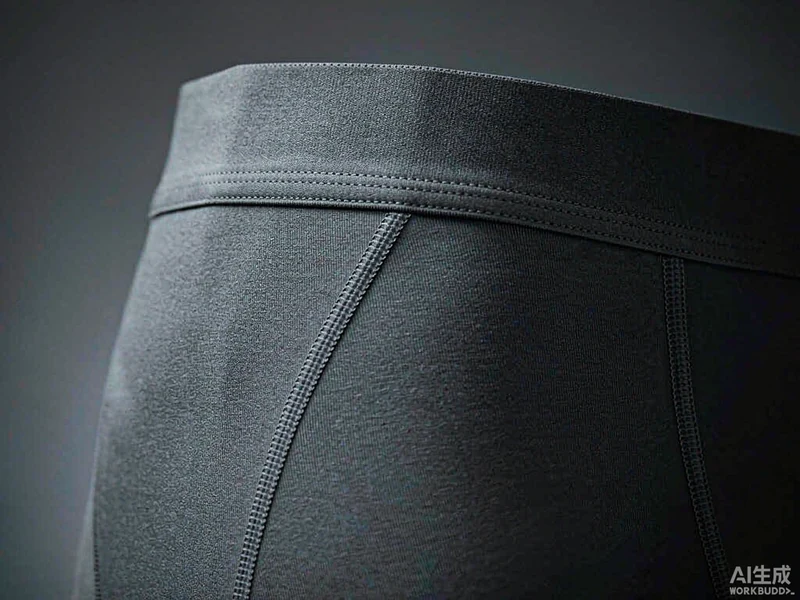
Quick answer: Leggings are forgiving because a single stretch axis absorbs most fit error. Shorts fail when rise and inseam fight each other for the same fabric width. Jumpsuits fail when torso length is treated as a size dimension rather than a fixed pattern variable. Each failure has a specific construction fix, and none of them is solved by adding more stretch.
Most activewear fit knowledge is derived from leggings and then applied to everything else. That works until it does not, and shorts and one-piece styles are where it stops working. This covers the three failure modes specific to those categories and the specification points that prevent them.
Why shorts are harder than leggings
A legging is essentially a tube with a controlled circumference. Fit error in circumference is absorbed by stretch, and the product still functions. A short introduces a second free edge — the hem — and the relationship between the rise (waist to crotch) and the inseam (crotch to hem) determines whether the garment rides up, gapes at the leg opening, or stays put.
The mechanism: when a short is cut from a four-way stretch fabric, the fabric wants to return to its un-stretched state. At the thigh, that recovery pulls the hem upward. The shorter the inseam and the closer the leg opening to the thigh circumference, the stronger that pull. This is why a 4-inch inseam short will ride up on a wearer with a larger thigh circumference even at the same waist size, and why a 7-inch short in the same fabric does not.
The three shorts parameters that decide the outcome
| Parameter | What it controls | Failure mode if wrong |
|---|---|---|
| Leg opening circumference | How much the fabric is stretched around the thigh | Too tight: hem rolls and rides up. Too loose: gapes and shows through in a squat |
| Inseam length | How much fabric anchors the hem against recovery | Too short: rides up in motion. Too long: interferes with knee flexion |
| Rise | Where the waist sits and how much fabric spans the crotch | Too low: pulls down at the back in a hinge. Too high: bunches at the waist |
The practical rule we work to: set the leg opening at roughly 88-92% of the intended wearer thigh circumference, and treat the inseam as a function of that percentage rather than a fixed number. A short with a leg opening at 85% needs a longer inseam to stay put; the same style at 95% can run shorter.
Gusset geometry, and why it matters more in shorts
The gusset is a small panel inserted at the crotch to remove the four-way seam intersection that causes both abrasion and seam failure. In leggings it is standard. In shorts it is often omitted because the leg is already open, and that omission is a mistake: without a gusset, the crotch seam is a single point of tension in exactly the position where a squat puts maximum load.
A diamond gusset of 8-12 cm along the long axis, cut from the same fabric and sewn with flatlock, is the specification that resolves this. It should be reflected in the pattern, not added at the sample stage.
Why jumpsuits fail, and it is almost always torso length
A jumpsuit is a one-piece garment that must satisfy two vertical requirements simultaneously: the rise must match the wearer, and the torso length from waist to shoulder must match the wearer. In a two-piece outfit these are independent; in a one-piece a single pattern dimension governs both.
This is why a jumpsuit can fit perfectly at the waist and still pull at the shoulders, or fit the torso and hang loose at the crotch. The garment is over-constrained, and the standard approach of grading every dimension proportionally produces a garment that fits the middle of the size range and neither end.
The construction fixes that actually work
| Problem | Construction fix | Trade-off |
|---|---|---|
| Torso too short, pulls at shoulders | Add a waist seam or a horizontal stretch panel at the waist | Changes the design line; requires pattern rework |
| Crotch hangs low, bunches at the knee | Increase the crotch curve depth and add a gusset | More fabric at the crotch; can look bulky in a slim silhouette |
| Waist rolls in movement | Use a wider elastic (minimum 4 cm) with a silicone grip band | Slightly higher cost per unit |
| Rise pulls down in a hinge | Extend the back rise relative to the front rise | Requires a separate front and back pattern block |
| Strap digging at the shoulder | Widen the strap and move the attachment point inward | Limits the design to wider-strap styles |
The specification checklist
For shorts and one-piece activewear, these are the parameters that must be in the tech pack with tolerances:
- Front rise and back rise specified separately, with tolerance ±0.5 cm.
- Leg opening circumference, specified as a flat measurement plus the intended stretch percentage.
- Inseam measured from the crotch seam, with the gusset seam defined.
- For jumpsuits: total torso length from waist seam to shoulder seam, and the pattern block it derives from.
- Gusset dimensions and seam type.
- Elastic width, elongation at the waistband, and whether a silicone grip is specified.
- Grade rule, stated per dimension rather than as a single size scale.
How to test a sample before approving it
A static fit check on a mannequin will not reveal any of the failures above. Three tests that will:
- The hinge test — wearer bends forward 90 degrees and holds for five seconds. Watch the back rise and the leg opening. This exposes rise and recovery problems immediately.
- The squat-and-hold — a full squat held for five seconds. Watch the crotch seam and the leg opening. This is where gusset omission shows up.
- The reach test — arms overhead. For a jumpsuit, this is the only reliable test of torso length.
Run these on the same wearer who matches the mid-point of the target size range, and again on a wearer at the top of the range. A sample that passes both is a sample worth approving.
Frequently asked questions
Why do my yoga shorts ride up even though the waist fits?
Riding up is a leg-opening problem, not a waist problem. When the leg opening circumference is close to the thigh circumference, fabric recovery pulls the hem upward in motion. Widening the leg opening by 5-8% or lengthening the inseam resolves it; adding more stretch to the fabric makes it worse.
Do yoga shorts need a gusset?
Yes, if they are intended for movement. Without a gusset the crotch is a single four-way seam junction under maximum load in a squat, which is both a comfort and a durability problem. A diamond gusset of 8-12 cm on the long axis is the standard fix.
Why does my jumpsuit pull at the shoulders?
Torso length. In a one-piece, the distance from waist to shoulder is a single pattern dimension, and if it is short relative to the wearer the garment compensates by pulling at the shoulder or at the crotch. Adding a waist seam or a horizontal stretch panel at the waist is the most reliable fix.
Can I grade a jumpsuit the same way as a legging?
No. Proportional grading across all dimensions assumes the relationships between dimensions hold constant across sizes, which is not true for torso length and rise. Jumpsuits need a grade rule specified per dimension, and a size set measured at both ends of the range.
What waistband construction works best on one-piece activewear?
A wide elastic of at least 4 cm with a silicone grip band, sewn into a seam rather than applied as a fold-over. The wider elastic distributes load across more of the torso, and the grip band prevents the rolling that a narrow elastic develops in a one-piece garment.
Developing a shorts or jumpsuit style and want a fit review before sampling? Send us your brief and we will come back with a feasibility opinion within two working days.