
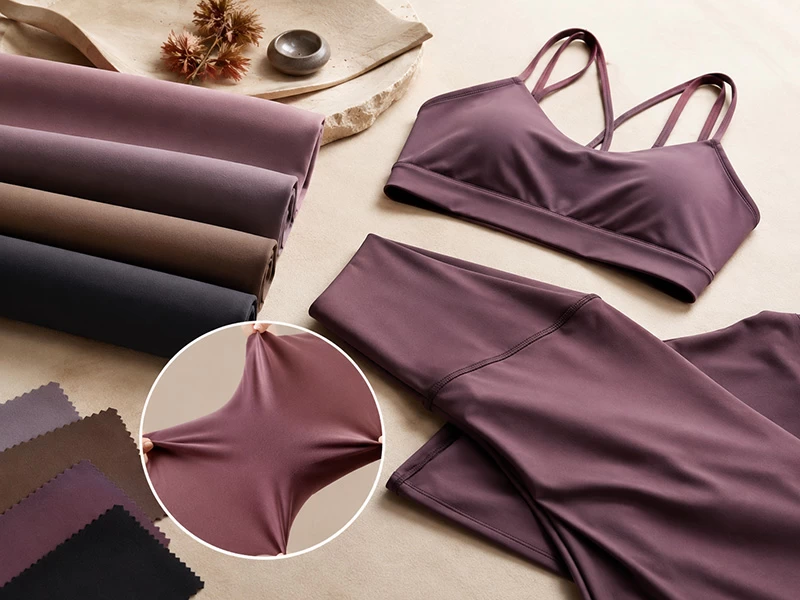
Quick answer: Activewear is a stretch-material discipline: the risk is in fit, recovery and seam integrity. Down outerwear is a material-handling discipline: the risk is in down containment, baffle construction and thermal consistency. They need different machines, different QC routines and different operator skills. A factory can run both — many do — but each category needs its own line, its own QC standards and its own production calendar.
Brands increasingly run both categories because their customer overlap is real: a yoga brand extends into a down vest, an outerwear brand adds a base layer. Understanding why the two are operationally different is what stops the extension from becoming a quality problem.
Materials: stretch versus containment
| Dimension | Activewear | Down outerwear |
|---|---|---|
| Core material | Knitted elastane blends, 4-way stretch, 150-300 gsm | Woven shells, down-proof, 30-70 gsm fabric plus fill |
| Primary risk | Stretch recovery, opacity, pilling | Down leakage, fill distribution, moisture |
| Material cost share | 40-55% of FOB | 50-70% of FOB |
| Sourcing lead time | Often in stock in the local market | Shell fabric may be custom; down is a commodity with certification |
| Handling | Rolls, low weight, high volume | High loft, bulky, requires controlled humidity |
The handling difference alone changes the factory layout. Activewear rolls can be stacked and moved by one person; a down-filled bundle occupies several times the space and needs a filling area with extraction, because loose down becomes airborne and contaminates everything nearby.
Machines and construction
| Requirement | Activewear | Down outerwear |
|---|---|---|
| Core machines | Overlock, flatlock, coverstitch, bonding press | Single-needle lockstitch, baffle machines, down filling equipment |
| Specialist equipment | Seamless knitting machines, ultrasonic bonding | Down filling machine, baffle templates, down-proof seam sealing |
| Stitch density | Lower, to preserve stretch | Higher, to prevent leakage |
| Seam type | Flatlock and bonded, minimal bulk | Folded and topstitched, with seam sealing on exposed baffles |
| Typical defect mode | Seam grin, recovery loss, opacity | Down escape, cold spots, baffle distortion |
The stitch density difference is fundamental. An activewear seam needs to stretch with the fabric, so high stitch density causes seam failure under extension. A down seam needs to be tight enough that down clusters cannot migrate through the needle holes, which is close to the opposite requirement. The same operator cannot simply switch habits between the two.
Quality control: different failure modes, different checks
Activewear QC
- Measurement audit in the relaxed state, after a stated resting period.
- Seam extension test — the seam is stretched and inspected for grin or stitch cracking.
- Opacity check against a defined standard, particularly on light colours.
- Recovery check — measure, stretch, release, re-measure after a defined interval.
- Fit verification in motion, on a live wearer at both ends of the size range.
Down outerwear QC
- Down content verification — species and ratio, by test report rather than declaration.
- Fill weight verification per garment, by weighing.
- Baffle integrity — inspection for gaps at the seam and at the baffle ends.
- Down escape test — a defined agitation test followed by surface inspection.
- Distribution check — backlighting and manual assessment for cold spots.
Note that almost none of the checks overlap. A factory running both categories needs two QC routines, two sets of standards, and ideally two inspectors — not one routine applied to both.
Seasonality, and why it forces a calendar decision
This is the practical constraint that catches brands out. Activewear peaks for spring and summer delivery, with production running from January to April. Down outerwear peaks for autumn and winter delivery, with production running from June to October.
At first glance this looks ideal — the two categories fill opposite halves of the year, and a factory running both has year-round loading. In practice the overlap sits in the middle: sampling and development for both categories cluster in the same window, and factories that run both often have a capacity crunch in the second and third quarters when activewear bulk and outerwear development coincide.
For a brand running both categories, the consequence is that you should place development work earlier than the calendar suggests, because the factory's sampling capacity is contested exactly when your development is due.
What this means for choosing a factory
| If you run | Look for | Avoid |
|---|---|---|
| Activewear only | Deep stretch construction capability, flatlock and bonding, fit-testing discipline | A factory where activewear is a small share of output |
| Down only | Down handling, filling equipment, down test reports, baffle construction | A factory without an enclosed filling area |
| Both | Separate lines and separate QC routines per category, and honesty about which is stronger | A factory claiming equal strength in both without evidence |
The honest position for a dual-category factory
A factory running both categories will be stronger in one than the other, and the useful question is which. Ours is activewear, with down outerwear as a substantial second line — which means our QC standards, operator training and machine base are built around stretch construction first, and down outerwear benefits from a separate line with its own standards. That is a more useful answer than claiming parity, because it tells you where to place your most demanding work.
Frequently asked questions
Can one factory make both activewear and down outerwear?
Yes, and many do, because the seasonal loading complements well. But each category needs its own production line, machine base and QC routine. The failure mode is a factory running both on shared equipment with a single quality standard, which usually means one category is compromised.
Why can't the same sewing operators work on both?
Because the seam requirements are close to opposite. Activewear seams need low stitch density to stretch with the fabric; down seams need high density to prevent fill escaping through needle holes. The habits that make a good activewear operator conflict with what makes a good down operator.
What are the main quality risks in activewear manufacturing?
Seam grin and stitch cracking under extension, recovery loss after washing, opacity on light colours, and measurement drift because the fabric is measured in a distorted state. All four are addressed by specified tests rather than visual inspection.
What are the main quality risks in down outerwear?
Down escape through seams and shell, uneven fill distribution causing cold spots, baffle distortion, and inaccurate down content. These require verification by test report and weighing rather than by visual inspection alone.
Why do activewear and down outerwear seasons conflict?
Production seasons are complementary — activewear bulk runs January to April, down bulk June to October — but development for both clusters in the same window, so sampling capacity is contested. Brands running both should schedule development earlier than the delivery calendar implies.
Running both categories and want our capability split by line? Send us your brief and we will come back with a feasibility opinion within two working days.