
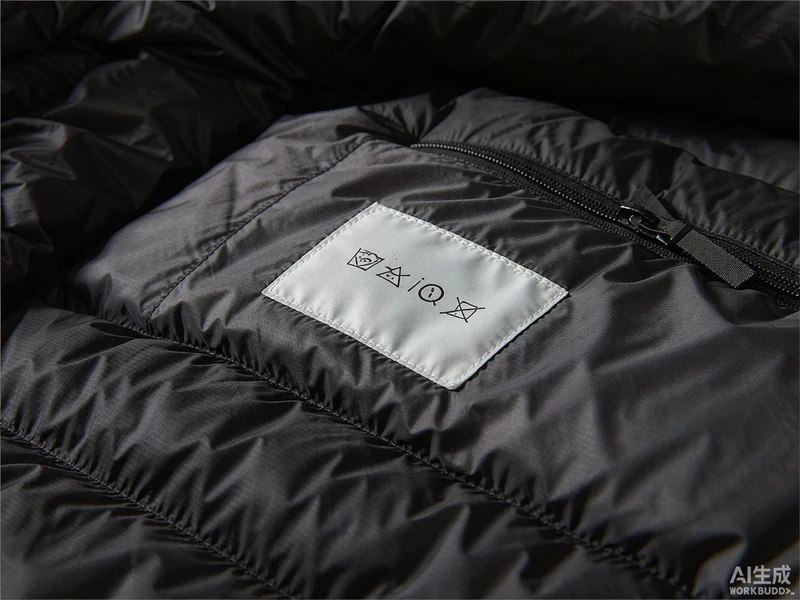
Quick answer: Care labelling for down outerwear is both a legal obligation and a performance decision. The label determines how the customer washes the garment, and incorrect washing is the leading cause of loft loss and clumping in the field. Specify the care instructions against the actual shell and fill combination — not from a template — and make sure the wash test data supports what the label claims.
Down is a durable fill. A well-specified jacket washed on the correct cycle will retain most of its loft over many seasons. The failures customers report — clumping, cold spots, fill shifting to one corner — are almost always caused by washing method rather than fill quality, and the washing method is set by the care label you write.
The regulatory baseline
Care labelling obligations differ by market, and getting them wrong is one of the few apparel compliance failures that carries direct enforcement risk rather than only commercial cost.
| Market | Requirement | Practical note |
|---|---|---|
| EU | Fibre composition labelling mandatory under Regulation (EU) No 1007/2011; care instructions are governed by national rules and the EN ISO 3758 care symbol standard | Symbols must follow the standard set; national language requirements vary by member state |
| US | Country of origin, fibre content and care instructions required under the FTC Textile Rules; RN number where applicable | Care instructions must be in English and must be based on a reasonable basis — normally a wash test |
| UK | Similar to EU requirements, separately enforced | Do not assume an EU label set is sufficient post-Brexit |
| Canada | Bilingual (English and French) labelling requirements | A common omission for brands entering Canada from an EU or US base |
Two practical consequences. First, care instructions in the US must have a reasonable basis, which in practice means wash-test data — a label written from a template without testing is a compliance exposure, not just a quality risk. Second, the down content claim itself is regulated: the ratio and the species must be accurate, and "down" cannot be used loosely for a feather-heavy fill.
Why care instructions drive fill retention
Four mechanisms cause loft loss in domestic washing, and each is addressed by a specific instruction:
| Mechanism | What happens | Instruction that prevents it |
|---|---|---|
| Detergent residue | Surfactant residue coats the down cluster and collapses loft | Specify a down-specific or mild detergent, and an extra rinse cycle |
| Mechanical agitation | Wet down clusters migrate inside the baffle and clump | Front-load, low spin, and no agitator — specify gentle or down cycle |
| Incomplete drying | Damp down clumps permanently and develops odour | Tumble dry low with dryer balls until fully dry, and specify a long dry time |
| Fabric softener | Coats the fibres and reduces both loft and water repellency | Explicit prohibition on softener |
The single most damaging instruction a brand can print on a down jacket is "dry clean only" when the garment is not suited to it, or omitting drying guidance entirely. Wet down that is air-dried without mechanical tumbling will clump, and the customer will attribute it to the fill rather than to the instruction.
What the care label should specify for down outerwear
- Wash cycle — front load, gentle or down-specific programme, with a stated maximum temperature.
- Detergent type — mild or down-specific, non-biological, and an explicit prohibition on fabric softener.
- Rinse — an additional rinse cycle to remove surfactant residue.
- Spin — low spin speed, with a stated maximum.
- Drying — tumble dry low with dryer balls, and an instruction to continue until fully dry.
- A statement that the garment should not be air-dried flat, or should not be stored compressed.
- Ironing and bleaching guidance, usually "do not iron" and "do not bleach".
Where the shell fabric carries a DWR finish, the label should also note that the finish benefits from a low-heat tumble dry to reactivate. This is a genuine performance instruction, not a marketing line — a DWR that is never heat-reactivated loses water repellency after a few washes even though the finish is intact.
The specification points that protect loft before the customer ever washes it
Baffle construction
Sewn-through baffles create cold spots at every stitch line because there is no fill at the seam. Box-wall or stitchless bonded baffles eliminate that, at higher cost and weight. For a jacket rated for genuine cold, box-wall construction in the torso is the specification that matters; for a light fashion layer, sewn-through is acceptable.
Fill weight versus fill power
These are separate decisions and should be specified separately. Fill power describes the quality of the down — how much volume a given weight occupies. Fill weight describes how much is in the garment. A 700 fill power jacket with adequate fill weight will outperform an 800 fill power jacket that is underfilled, and underfilling is the more common cost-down tactic.
Baffle fill distribution
Specify fill weight per baffle or per body zone rather than a single total. A jacket with the same total fill concentrated in the torso and thin at the sleeves will feel cold at the arms, and the total number on the spec sheet will not reveal it.
A wash-test protocol worth adopting
Before approving production, wash three samples to the proposed label instructions and evaluate:
- Loft recovery after full drying — measure the baffle height at three points and compare to the pre-wash measurement.
- Cluster distribution — assess by feel and by backlighting the garment.
- Shell appearance — check for seam grin, DWR loss and colour change.
- Weight change — a gain of more than 1-2% suggests detergent residue retention.
Five wash cycles is a reasonable proxy for a season of use, and the result should be documented as the reasonable basis for the US care instruction claim.
Frequently asked questions
What care instructions should a down jacket have?
Front-load machine wash on a gentle or down-specific cycle at a stated maximum temperature, mild or down-specific detergent with no fabric softener, an extra rinse, low spin, and tumble drying on low with dryer balls until fully dry. The drying instruction is the most important one and the most commonly omitted.
Is dry cleaning bad for down jackets?
It depends on the solvent and the shell fabric, and it is not a safe default. Many dry-cleaning processes strip natural oils from down and can affect DWR finishes. Unless the specific solvent has been tested against the garment, machine washing to a tested protocol is the safer instruction.
Does care labelling differ between the EU and the US?
Yes. The EU requires fibre composition under Regulation (EU) No 1007/2011 with care symbols following EN ISO 3758 and national language rules. The US requires fibre content, country of origin and care instructions under the FTC Textile Rules, and the care instruction must have a reasonable basis, normally documented wash testing.
Why does my down jacket clump after washing?
Almost always because it was not fully dried with mechanical agitation. Wet down clumps and stays clumped if air-dried flat. Tumble drying on low with two or three dryer balls, continued until completely dry, redistributes the clusters and restores loft.
How many washes should a down jacket survive?
A well-specified jacket washed on a correct cycle should retain most of its loft over 20 or more washes. The variables that shorten that are detergent residue, high spin speeds, incomplete drying and fabric softener — all of which are controlled by the care label.
Need care labels written against your actual shell and fill, with wash-test support? Send us your brief and we will come back with a feasibility opinion within two working days.